Chemical Reaction Optimization with Catalyst Constraints
This example demonstrates the use of interpoint constraints, which can be used to apply restrictions on plates (batches) of experiments rather than on individual experiments. For more details on interpoint constraints, we refer to the constraints user guide.
The Scenario
For the example, we consider a microscale HTE optimization scenario carried out on a small plate with four experiments (e.g., a subset of a 96-well plate). The goal is to optimize reaction conditions for this plate where exactly 8 µmol of a certain catalyst must be used for the entire plate while not using more than 1.2 mL of solvent in total.
This scenario illustrates two common challenges in laboratory settings:
First, it demonstrates how to enforce a catalyst requirement: Exactly 8 µmol of the catalyst must be used across the entire plate since the catalyst is supplied in a sealed sensitive package that cannot be reused once opened.
Second, it shows how to include a solvent budget constraint for controlling the total solvent consumption across experiments for cost efficiency.
Imports and Settings
import os
import pandas as pd
from matplotlib import pyplot as plt
from baybe import Campaign, active_settings
from baybe.constraints import ContinuousLinearConstraint
from baybe.parameters import NumericalContinuousParameter
from baybe.recommenders import BotorchRecommender
from baybe.recommenders.meta.sequential import TwoPhaseMetaRecommender
from baybe.searchspace import SearchSpace
from baybe.targets import NumericalTarget
from baybe.utils.dataframe import add_fake_measurements
SMOKE_TEST = "SMOKE_TEST" in os.environ
BATCH_SIZE = 4
N_ITERATIONS = 2 if SMOKE_TEST else 15
TOLERANCE = 0.01
active_settings.random_seed = 1337
Problem Definition
We consider a synthetic chemical reaction with the following microscale HTE parameters:
Solvent Volume (0.05-0.30 mL per experiment): The amount of solvent used
Reactant Concentration (0.05-0.20 mol/L): Primary reactant concentration
Catalyst Amount (0.5-5 µmol): Absolute catalyst amount per experiment
Temperature (60-110 °C): Reaction temperature
Note that the parameter ranges are chosen arbitrarily and do not correspond to any specific real-world reaction.
parameters = [
    NumericalContinuousParameter(
        name="Solvent_Volume", bounds=(0.05, 0.30), metadata={"unit": "mL"}
    ),
    NumericalContinuousParameter(
        name="Reactant_Conc", bounds=(0.05, 0.20), metadata={"unit": "mol/L"}
    ),
    NumericalContinuousParameter(
        name="Catalyst_Amount", bounds=(0.5, 5.0), metadata={"unit": "µmol"}
    ),
    NumericalContinuousParameter(
        name="Temperature", bounds=(60.0, 110.0), metadata={"unit": "°C"}
    ),
]
Constraint Definition
For the example, the following constraints are applied:
Reagent efficiency: For each experiment, the solvent volume must satisfy \(V_{\mathrm{solvent}} \ge k \cdot C_{\mathrm{reactant}}\) with \(k = 1.5\,\mathrm{mL\cdot L/mol}\) (to ensure proper dilution).
Catalyst constraint: The total catalyst amount across all experiments in a plate must equal exactly 8 µmol.
Solvent budget: The total solvent used for each plate should be at most 1.2 mL.
The first constraint is an intrapoint constraint since it applies to individual experiments. The latter two are interpoint constraints as they apply to a plate as a whole.
intrapoint_constraints = [
    ContinuousLinearConstraint(
        parameters=["Solvent_Volume", "Reactant_Conc"],
        operator=">=",
        coefficients=[1, -1.5],
        rhs=0.0,
    ),
]
interpoint_constraints = [
    ContinuousLinearConstraint(
        parameters=["Catalyst_Amount"],
        operator="=",
        coefficients=[1],
        rhs=8.0,
        interpoint=True,
    ),
    ContinuousLinearConstraint(
        parameters=["Solvent_Volume"],
        operator="<=",
        coefficients=[1],
        rhs=1.2,
        interpoint=True,
    ),
]
Campaign Setup
With these components in place, we can now define our search space and set up the corresponding experimental campaign:
searchspace = SearchSpace.from_product(
    parameters=parameters,
    constraints=intrapoint_constraints + interpoint_constraints,
)
objective = NumericalTarget(name="Reaction_Yield").to_objective()
recommender = TwoPhaseMetaRecommender(
    recommender=BotorchRecommender(sequential_continuous=False)
)
campaign = Campaign(
    searchspace=searchspace,
    objective=objective,
    recommender=recommender,
)
Optimization Loop with Constraint Validation
Next, we run several optimization iterations and validate that the interpoint constraints are satisfied for each plate to ensure the optimization respects our resource limitations:
results_log = []
for it in range(N_ITERATIONS):
    recommendations = campaign.recommend(batch_size=BATCH_SIZE)

    add_fake_measurements(recommendations, campaign.targets)
    campaign.add_measurements(recommendations)
    total_sol = recommendations["Solvent_Volume"].sum()
    total_cat = recommendations["Catalyst_Amount"].sum()
    solvent_ok = total_sol <= (1.2 + TOLERANCE)
    catalyst_ok = abs(total_cat - 8.0) < TOLERANCE

    assert solvent_ok, f"Solvent constraint violated: {total_sol:.2f} mL (max 1.2 mL)"
    assert catalyst_ok, (
        f"Catalyst constraint violated: {total_cat:.1f} µmol (expected 8.0 µmol)"
    )

    results_log.append(
        {
            "iteration": it + 1,
            "total_solvent_mL": total_sol,
            "total_catalyst_µmol": total_cat,
            "individual_solvent_mL": recommendations["Solvent_Volume"].tolist(),
            "individual_catalyst_µmol": recommendations["Catalyst_Amount"].tolist(),
        }
    )
Visualization
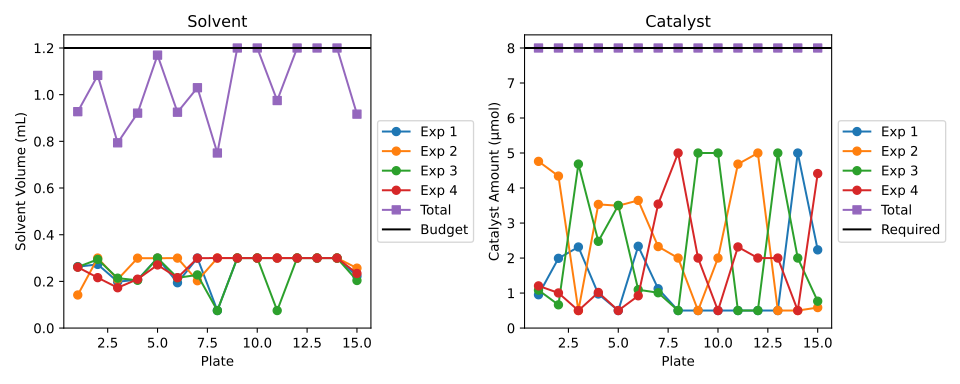
The plots below show the parameter values of individual experiments (labeled Exp <n>)
and as well as their totals over the respective plate (labeled Total), to
illustrate the effects of the two interpoint constraints:
The total solvent used for any individual plate never exceeds the given budget of 1.2 mL, even though the exact amount varies across plates and distributes differently among individual experiments.
By contrast, the total catalyst amount per plate is always exactly 8 µmol, even though individual experiments have varying amounts.
fig, axs = plt.subplots(1, 2, figsize=(10, 4));
plot_configs = [
    {
        "ax": axs[0],
        "individual_col": "individual_solvent_mL",
        "total_col": "total_solvent_mL",
        "y": 1.2,
        "label": "Budget",
        "title": "Solvent",
        "ylabel": "Solvent Volume (mL)",
    },
    {
        "ax": axs[1],
        "individual_col": "individual_catalyst_µmol",
        "total_col": "total_catalyst_µmol",
        "y": 8,
        "label": "Required",
        "title": "Catalyst",
        "ylabel": "Catalyst Amount (µmol)",
    },
]
results_df = pd.DataFrame(results_log)
for config in plot_configs:
    plt.sca(config["ax"])

    for exp_idx, values_per_exp in enumerate(
        zip(*results_df[config["individual_col"]]), start=1
    ):
        plt.plot(
            results_df["iteration"],
            values_per_exp,
            "o-",
            label=f"Exp {exp_idx}",
        )

    plt.plot(
        results_df["iteration"],
        results_df[config["total_col"]],
        "s-",
        label="Total",
        zorder=0,
    )

    plt.axhline(y=config["y"], label=config["label"], color="black")
    plt.ylim(bottom=0)
    plt.title(config["title"])
    plt.xlabel("Plate")
    plt.ylabel(config["ylabel"])
    plt.legend(loc='center left', bbox_to_anchor=(1, 0.5));
    plt.tight_layout()
if not SMOKE_TEST:
    plt.savefig("interpoint.svg")